
Skip to content

Advent 2026 · five December departures

Christmas markets by coach.

Mulled wine in Alsace, light art on Amsterdam's canals, half-timbered houses in the Eifel. Every departure starts in North Rhine-Westphalia — and this page also carries what others leave out: when each market actually opens, and when it gets dark.

5
Christmas departures
from €49
per person
4
boarding points in NRW

Why a Christmas market works better by coach

A Christmas market trip rarely fails because of the destination — it fails on logistics. Strasbourg's Grande Île is closed to all motor traffic during market hours, with access controls at the bridges. In Bruges the coach park at Bargeplein costs between €29 and €55. And in Amsterdam vehicles over 7.5 tonnes may not enter the city centre at all without an exemption — the fine is €1,160.

Our December departures leave from four fixed boarding points in the Ruhr area and the Lower Rhine: Dortmund, Duisburg, Essen and Düsseldorf. You get on; access permits, drop-off points and the return journey are our problem. In Strasbourg we stop at the Parc de l'Étoile — from there it is about a 15-minute walk via the Place du Corbeau and the “Porte des Lumières” to the market by the cathedral.

Four of the five departures are day trips: out in the morning, back at night, no hotel booking, no luggage. If you would rather take Alsace slowly, the two-day trip to Strasbourg and Colmar includes one hotel night — and it falls exactly on St Nicholas' Day. Every price on this page is a final price per person.

What you should know before booking

Four things that other sites get wrong or never mention. We checked all four with the cities themselves.

  • Riquewihr closes on 20 December — our tour falls on the final day

    The Riquewihr Christmas market runs from 27 November to 20 December 2026. Our 20 December departure therefore lands on the closing day, open 10:00 to 19:00. That is a genuine last chance — but on the final day some traders start packing up early, so we are deliberately there early. Anyone reading that Riquewihr is open “until the end of December” is reading wrong information.

  • Monschau opens on only four Advent weekends

    The market is closed on weekdays. Open in 2026: 27–29 November, 4–6 December, 11–13 December and 18–20 December, Friday to Sunday only. Our departure on Saturday 19 December falls inside the last block, so the market is open, 11:00 to 21:00. To be straight with you: the additional craft market of roughly ten further stalls only takes place on the first two December weekends. It will not be there on 19 December, so we do not promise it.

  • Bruges has no free light walk in 2026/27

    The free “Machina Lumina” light trail of the 2025/26 season is not continuing — we verified this directly with the City of Bruges. It is replaced by a lantern parade premiering in late January and a new, ticketed light show. Anyone travelling on 12 December will see the Christmas markets on the Markt and Simon Stevinplein, but not last year's light walk. Many travel sites still have this wrong.

  • Amsterdam has no German-style Christmas market

    That is not a shortcoming of the trip but a different idea of winter: Amsterdam turns its canals into an open-air museum of light. There is no large central market as in Cologne or Nuremberg — anyone expecting one will be disappointed. What there is: the Amsterdam Light Festival along the canals, and the Ice*Village on Museumplein (3–27 December, free entry, over 50 stalls), which falls exactly on our travel day.

Our Christmas market departures in December

In departure date order. Availability is taken live from the travel calendar.

The destinations in detail

Five very different ways to spend Advent. Opening hours and size figures come from the markets themselves.

France

Strasbourg

Open:
daily 11:30–21:00
Size:
8 official markets, over 300 chalets

The Christkindelsmärik began in 1570 and was for a long time the only Christmas market in France; the name means “market of the Christ Child” in Alsatian. Over the centuries it moved from the cathedral forecourt via the Place du Château and the Place Kléber to today's Place Broglie, settling there in the early 1870s. The “Strasbourg Capitale de Noël” brand was created in 1992, and the great fir has stood on Place Kléber since 2000. Today around two million visitors come each season. The city counts eight official markets, spread across the Grande Île, a UNESCO World Heritage site since 1988.

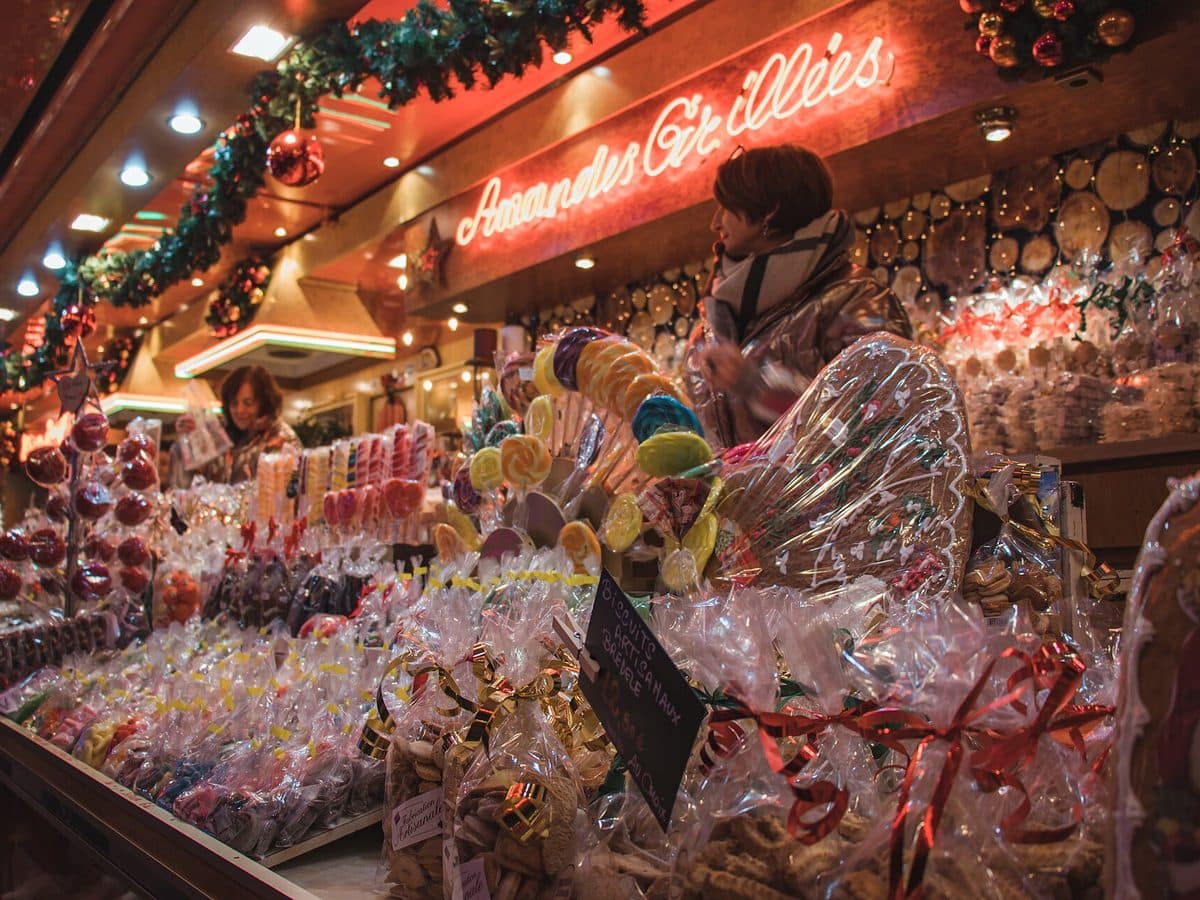
Here the baking is not a side note but the point: Bredele in dozens of varieties — cinnamon stars, aniseed biscuits, vanilla crescents, Linzer bites — alongside pain d'épices, which once hung on the tree as a decoration, and Springerle, shaped in carved wooden moulds. The official recipe for vin chaud calls for star anise, cinnamon stick, vanilla pod and orange peel. For crafts there are glass baubles, Advent wreaths, music boxes and painted wooden toys. The Marché OFF on Place Grimmeissen is another world entirely: a social-economy market built from shipping containers, with vintage furniture and upcycling workshops — nobody else writes about it.

On this trip

The city itself names Wednesday afternoon, Friday evening and the whole weekend as the busiest times — our trip falls on Saturday and Sunday. Go into the lanes early and fall back on La Petite France and the Marché OFF, which stay calmer. The official photo spot is the arch of the Christkindelsmärik. Deposit on the cup: €1, refundable at any drinks stand — or drop it in a donation box and the euro goes to a Strasbourg charity.

France

Colmar

Open:
Mon–Thu 11:00–19:00, Fri–Sun 10:00–20:00
Size:
6 markets; Dominicains ~60, Ancienne Douane ~50 chalets

Colmar spreads Advent across six separate markets rather than one large square, and each has a different character. On the Place des Dominicains the stained glass of the 14th-century Dominican church lights up from dusk. At the Place de l'Ancienne Douane stand the illuminated Koïfhus and Bartholdi's Schwendi fountain — the sculptor of the Statue of Liberty was born in Colmar. The Place Jeanne d'Arc plays an Alsatian village complete with its own herd of goats, while inside the Koïfhus a heated indoor market gathers potters, glassblowers and wood carvers. Dates for 2026: 23 November to 29 December.

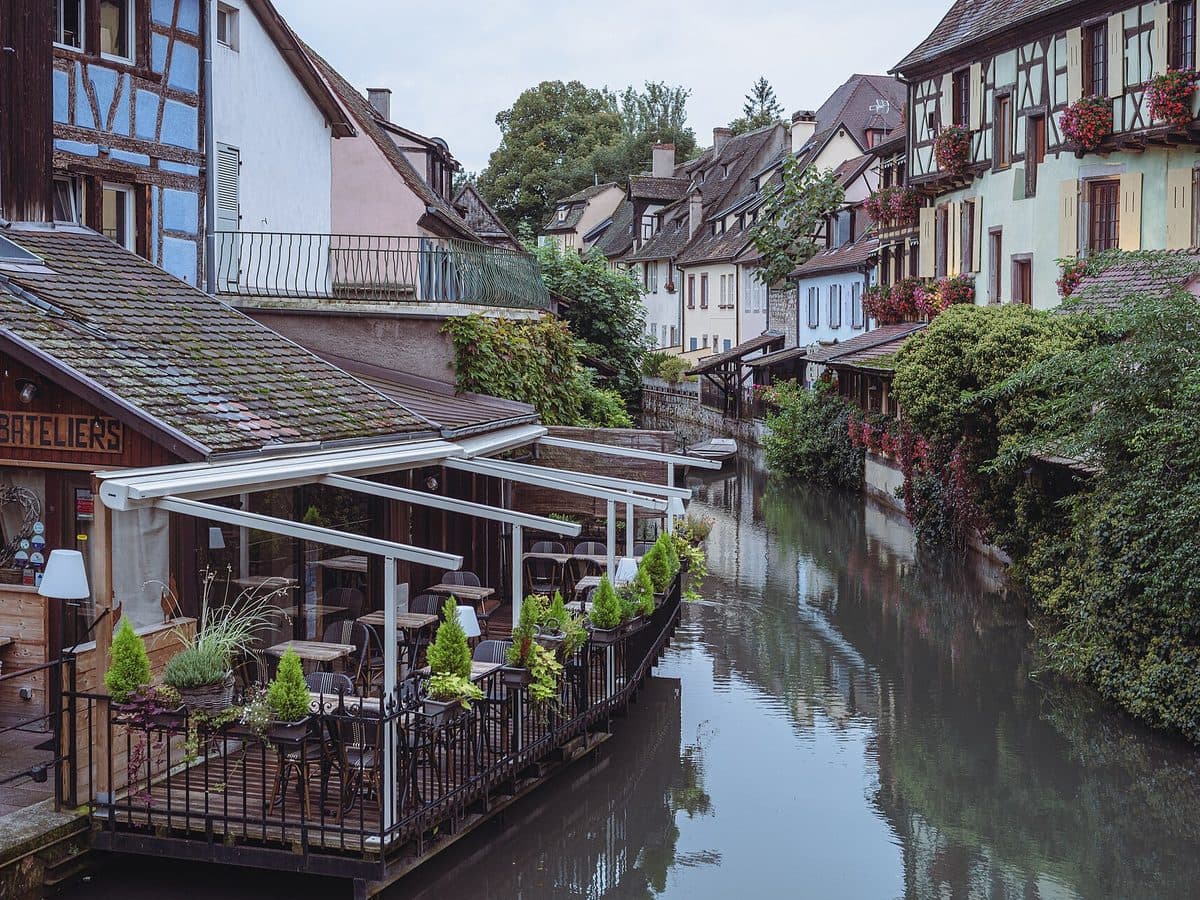
The children's market sits in the Petite Venise quarter: rabbits and sheep in the corners of the chalets, a mechanical nativity, a carousel, a giant letterbox for Father Christmas — and hot apple juice, “jus de pommes chaud”, which the city itself lists as part of the children's programme. The Marché gourmand on the Rue de la Montagne Verte brings together nine chalets run by nine maîtres restaurateurs, from oysters to dessert, with a cook show in the middle. Photographically there is no way past the Petite Venise, where the half-timbered houses are reflected in the Lauch.

On this trip

Both Colmar departures fall on a Sunday, which means the long hours of 10:00 to 20:00. At weekends a different rule applies to coaches: passengers alight at the Parking Lacarre, after which the coach moves to the Parc des Expositions and pays to park. For Riquewihr on 20 December the closing-day note above also applies. Colmar publishes no official deposit figure, so we quote none.

Netherlands

Amsterdam

Open:
lights on from 16:30
Size:
15th edition, route about 6.5 km

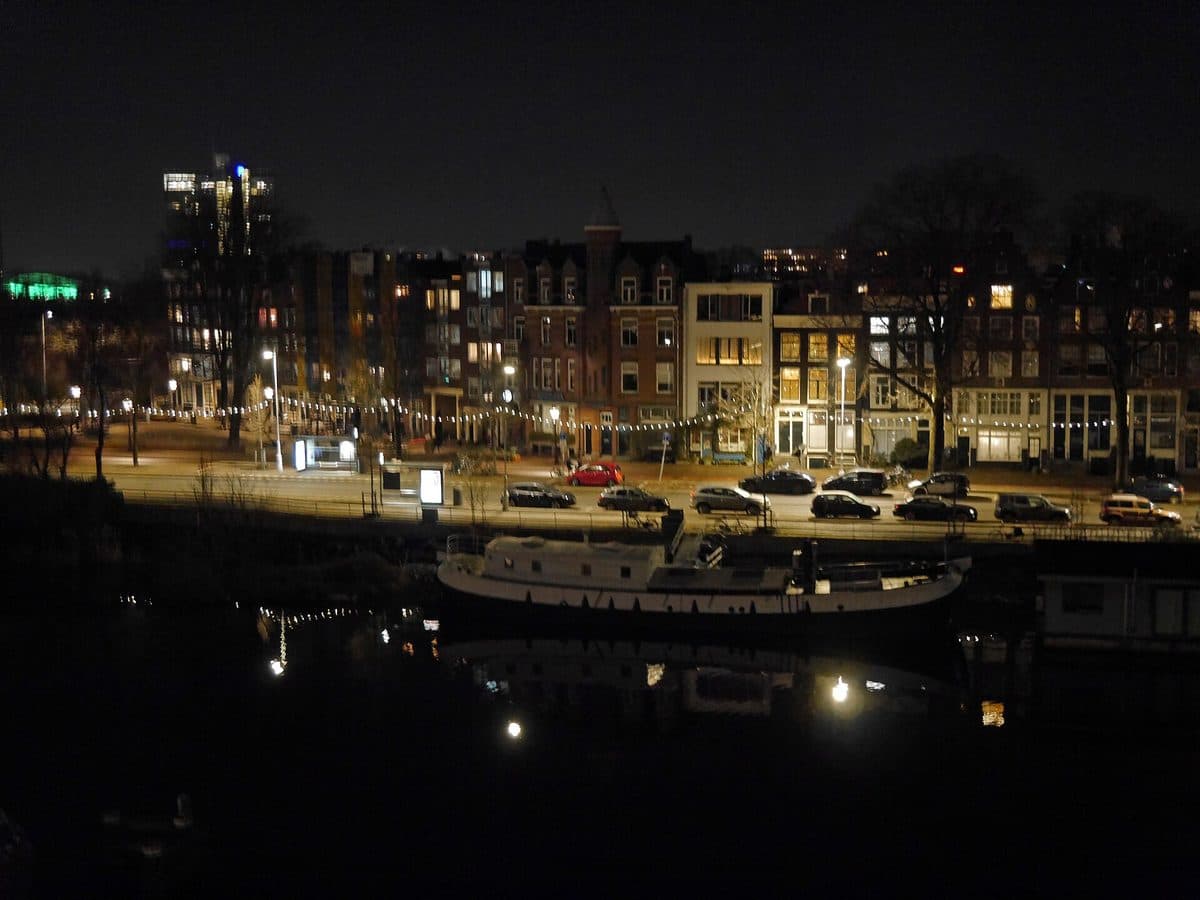
Amsterdam marks winter with art rather than stalls. The Light Festival runs its 15th edition from 26 November 2026 to 17 January 2027, showing installations by international artists along the canals. The walking route is about 6.5 kilometres and can be split in two; the works are designed to be seen from the water, which makes the boat trip along the Amstel, Herengracht and Oosterdok (75–90 minutes, at extra cost) the intended perspective. The theme of the 15th edition had not been published when this page was written, so we do not name one.

On food, honesty pays: erwtensoep, the thick pea soup, is genuine winter fare. Oliebollen and appelbeignets, however, belong to New Year rather than Christmas — looking for them in early December is looking a week early. Hot chocolate and mulled wine are there; during the St Nicholas period the orange version is called “bisschopswijn”. Photographically the routes lead to the Magere Brug, the seven-bridge view along the Reguliersgracht and the Golden Bend of the Herengracht.

On this trip

Of our five destinations Amsterdam is where darkness falls earliest: sunset 16:30, complete darkness 17:08. That is exactly when the festival switches on. Anyone back on the coach before then has seen nothing — which is why our schedule deliberately runs into the evening. Second point: in the Netherlands many stalls take cards only and no cash at all. Bring a debit card or phone payment.

Belgium

Bruges & Ghent

Open:
Bruges from 11:00; Ghent until midnight
Size:
Ghent over 150 wooden chalets

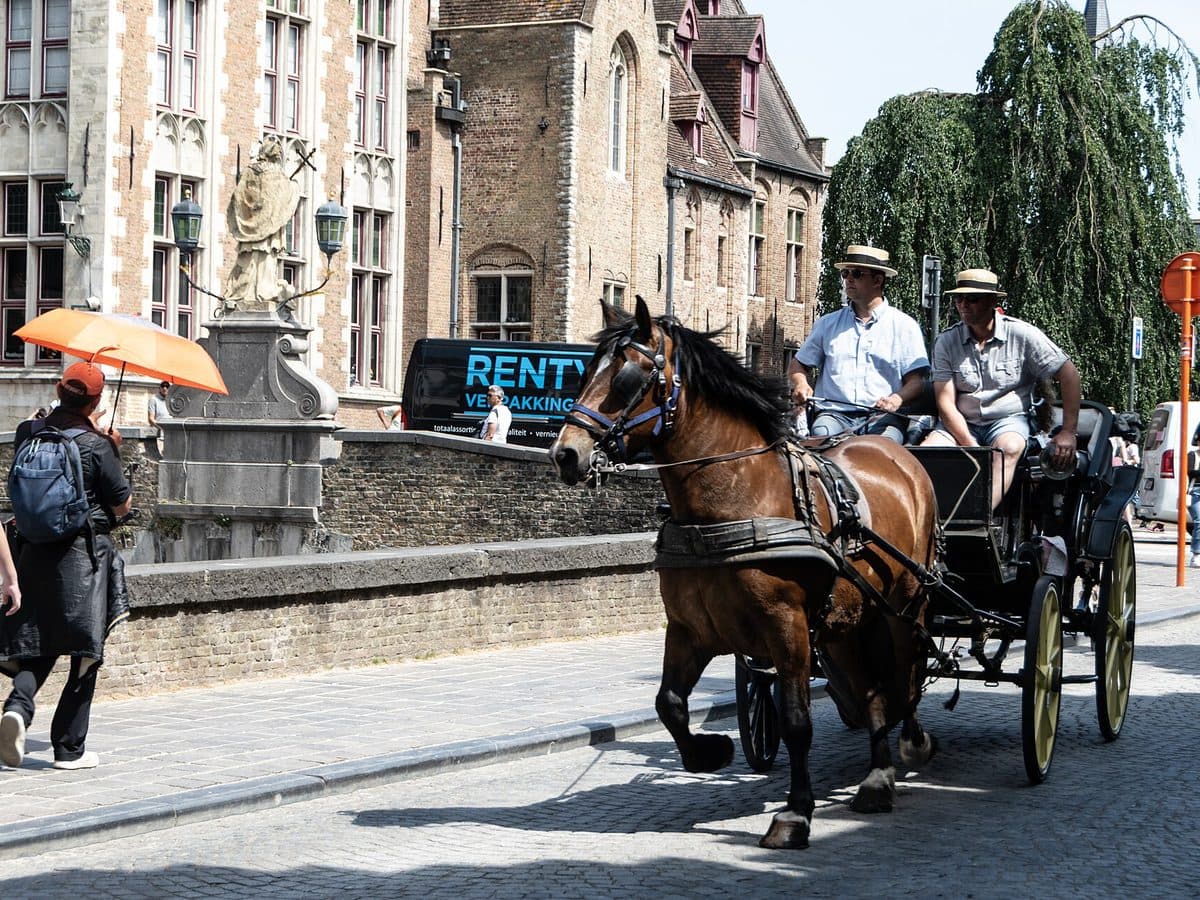
Two Flemish old towns in one day, at very different speeds. Bruges' historic centre is a UNESCO World Heritage site; the markets sit on the Markt in view of the 83-metre Belfry with its 47-bell carillon, and on the Simon Stevinplein among craftspeople and regional producers. Contrary to many listings the ice rink is not on the Markt but in the Koning Albert I park. Ghent is more of a student city and stays awake longer: the Gentse Winterfeesten run from Sint-Baafsplein along the Botermarkt and — the street name is real — “Klein Turkije” to the end of the Korenmarkt, with over 150 wooden chalets.

The Liège waffle, with its pearl sugar and caramelised pockets, is a different thing from the light, rectangular Brussels waffle — worth looking closely. The fried dough balls are called smoutebollen in Flemish, not oliebollen. Ghent's real speciality is the cuberdon: a cone-shaped violet sweet with a liquid raspberry centre, invented by accident in a Ghent pharmacy in 1873 and, because it keeps so briefly, barely found outside Belgium. Alongside it: Trappist beer — Belgian beer culture has been on the UNESCO list since 2016 — and Bruges bobbin lace, which sustained the city in the 17th century.

On this trip

In Belgium every trader must accept cash and offer at least one electronic payment method, so paying by card is far safer here than in Germany. Ghent's market stays open until midnight while Bruges closes earlier, which sets the order by itself: Bruges first, Ghent in the evening. The city says the most photographed spot is the Rozenhoedkaai; in Ghent the Sint-Michielsbrug frames all three towers in one shot.

Germany

Monschau

Open:
Fri & Sat 11:00–21:00, Sun 11:00–20:00
Size:
around 35 stalls

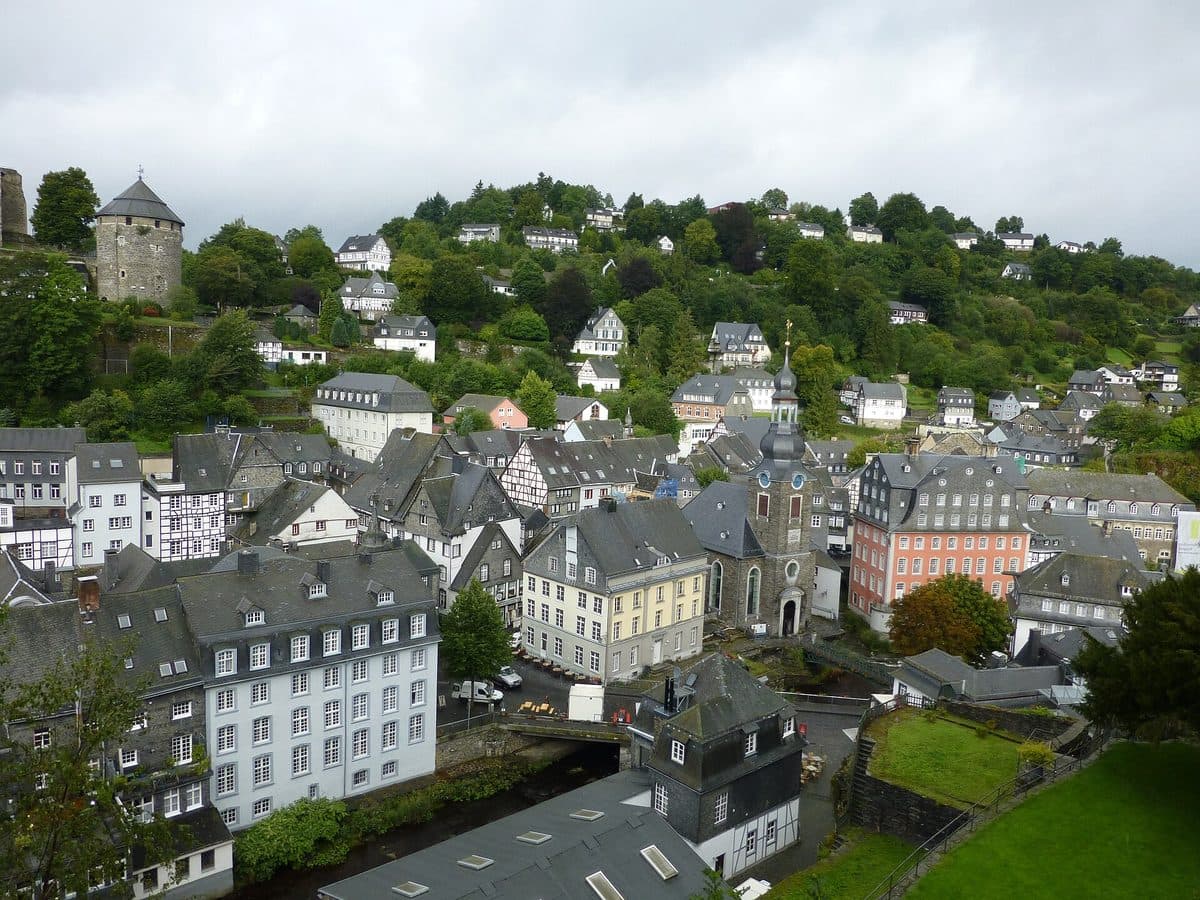
The smallest and closest destination: a half-timbered town in the Eifel, wedged into the narrow valley of the river Rur, with over 330 listed buildings and a townscape that has barely changed in some 300 years. The roughly 35 stalls spread across the Marktplatz, Gerberplatz, the Rur bridge and the area around the “Haus am Turm”. Above the town stands the medieval castle, today a youth hostel; the Rotes Haus, built around 1760 by the cloth merchant Scheibler, shows thirteen furnished rooms.

Confirmed on offer: mulled wine and cherry mulled wine, hand-roasted almonds with Eifel honey, and the Monschau mustard liqueur from the Senfmühle, which has worked since 1882 and gives guided tours. On baking, precision is due: Aachener Printen carry a protected geographical indication and may only be made in Aachen and five neighbouring municipalities — Monschau is not among them. What is sold here is therefore bought in or generic. After dark some 60,000 LEDs light the half-timbered façades; the shot of the day is from the Rur bridge around 17:00, with the castle behind.

On this trip

Of our five destinations Monschau is the coldest and wettest: a December average of 5.6 °C by day and 1.8 °C at night, with rain on nearly 17 days of the month. Waterproof shoes with a proper sole are not a suggestion here but a requirement. German Christmas markets also remain largely cash-based — bring cash. No official deposit figure is published, so we deliberately quote no exact number.

Christmas markets 2026: when does each market open?

The major markets in North Rhine-Westphalia and just across the border — with the dates we checked with the organisers themselves on 12 September 2026.

Totensonntag falls on 22 November in 2026. Most markets in North Rhine-Westphalia stay closed that day — worth knowing if you are planning for that weekend.

City & marketDates 2026ClosedOpening hours
EssenInternationaler Weihnachtsmarkt13 Nov – 23 Dec22 November 2026Sun–Thu 12:00–21:00, Fri–Sat 12:00–22:00; Volkstrauertag (15 Nov) 14:00–21:00
KölnDom / Roncalliplatz16 Nov – 23 Dec22 November 2026Sun–Wed 11:00–21:00, Thu–Fri 11:00–22:00, Sat 10:00–22:00
KölnNeumarkt · Markt der Engel16 Nov – 23 Dec22 November 2026Sun–Thu 11:00–21:00, Fri–Sat 11:00–22:00; closes 21:00 on 23 Dec
KölnHeumarkt · Heinzels Wintermärchen23 Nov – 10 Jan24 December 2026 · 25 December 2026daily 11:00–22:00, from 31 Dec 11:00–21:00
KölnRudolfplatz · Nikolausdorf16 Nov – 23 Dec22 November 2026Sun–Thu 11:00–21:00, Fri–Sat 11:00–22:00
DüsseldorfAltstadt-Märkte19 Nov – 30 Dec22 November 2026 · 25 December 2026Sun–Thu 11:00–20:00, Fri–Sat 11:00–21:00; 24 Dec 11:00–15:00, 26 Dec 14:00–21:00
DortmundWeihnachtsstadt19 Nov – 30 Dec22 November 2026 · 25 December 2026Mon–Thu 11:00–21:00, Fri–Sat 11:00–22:00, Sun 12:00–21:00; 24 Dec 11:00–14:00
BochumBochumer Weihnacht19 Nov – 23 Dec22 November 2026daily 11:00–22:00 (core hours 12:00–21:00)
AachenAachener Weihnachtsmarkt20 Nov – 23 Decno closing daysdaily 11:00–21:00; Totensonntag (22 Nov) only 18:00–21:00; Sat 12 Dec until 22:00; 23 Dec until 20:00
MünsterRathaus, Aegidii, Kiepenkerl23 Nov – 23 Decno closing daysSun–Thu 11:00–20:00, Fri–Sat 11:00–21:00
ValkenburgKerststad · Höhlenmärkte13 Nov – 3 Jan25 December 2026Caves: Mon–Fri 11:00–19:00, Sat–Sun 10:00–19:00; last entry 45 min before closing
ColmarSechs Weihnachtsmärkte23 Nov – 29 Decno closing daysMon–Thu 11:00–19:00, Fri–Sun 10:00–20:00; 24 Dec 11:00–17:00, 25 Dec 11:00–19:00, 26 Dec 11:00–20:00
RiquewihrMarché de Noël27 Nov – 20 Decno closing daysThe official listing gives no opening hours for Riquewihr.

Düsseldorf and Colmar in detail

For these two, one table row is not enough: in Düsseldorf two closing days decide your weekend, and in Colmar the six markets end on three different dates.

Düsseldorf

19 Nov – 30 Dec

42 days, several markets across the city centre — and two days when everything stays shut. The 2026 essentials, straight from Düsseldorf Tourismus.

Two closing days
The stalls stay closed on 22 November (Totensonntag, Germany's day of remembrance for the dead) and on 25 December. Both fall on a Sunday in 2026 — exactly when most visitors plan to come.
Short days around Christmas
Christmas Eve is open only from 11:00 to 15:00, and 26 December opens at 14:00. On all other days: Sunday to Thursday 11:00–20:00, Friday and Saturday 11:00–21:00.
More than stalls
The “Wheel of Vision” big wheel turns on Burgplatz and “Kö auf dem Eis” skating runs on Königsallee — both part of the city's winter programme, running alongside the markets.

Colmar

23 Nov – 29 Dec

Six markets in an old town you can cross in half an hour — but with three different end dates. Plan it wrong and you arrive to dismantled stalls.

Place de l'Ancienne Douane
The largest of the six: close to fifty wooden chalets around the Schwendi Fountain, in the middle of the old town. 23 November to 29 December.
Place des Dominicains — closes earlier
This one ends on 23 December, six days before the others. In the evening the Gothic Dominican church is lit up, its stained glass dating from the 14th century.
Marché Gourmand — runs longest
Nine cabins with chefs and Alsatian specialities, open daily 11:00–22:00 and running until 3 January 2027 (until 17:00 on 31 December). Come between Christmas and New Year and this one is still busy.
Petite Venise and Place Rapp
The canal quarter hosts the children's market and Place Rapp gets winter décor with frosted firs. Add Place Jeanne d'Arc and that makes the six.

Essen · Internationaler Weihnachtsmarkt

Essen opens at 12:00, not 11:00. Several portals say 11:00 and also list 16 November as Volkstrauertag — those are recycled 2025 figures.

Köln · Heumarkt · Heinzels Wintermärchen

The only Cologne market running into January — the ice rink stays open until 10 January 2027. The Alter Markt section, however, ends on 23 December.

Düsseldorf · Altstadt-Märkte

Careful with sources: a site called “weihnachten-in-duesseldorf.de” gives 20 November as the start. Despite the name it is not official but belongs to a private publisher. Düsseldorf Tourismus states 19 November.

Dortmund · Weihnachtsstadt

On 24 December only some stalls open and the market closes at 14:00. It continues between Christmas and New Year with hours varying by day.

Aachen · Aachener Weihnachtsmarkt

Aachen is the only market here that opens at all on Totensonntag — but only from 18:00. All the others stay closed that day.

Münster · Rathaus, Aegidii, Kiepenkerl

The City of Münster's page carries the year 2026 but states itself that the details refer to 2025. The figures here therefore come from the market operators. The Lichtermarkt at St. Lamberti ends a day earlier, on 22 December.

Valkenburg · Kerststad · Höhlenmärkte

The two cave markets (Gemeentegrot and Fluweelengrot) close on 30 December; the Kerststad as a whole runs until 3 January 2027. Inside the caves the temperature stays around 10 °C all year — a jacket is needed even in mild weather.

Colmar · Sechs Weihnachtsmärkte

Colmar is not one market but six — and they do not all end on the same day. The market on Place des Dominicains closes on 23 December, while the Marché Gourmand runs until 3 January 2027. Come between Christmas and New Year and you will not find all six open.

checked on 12 September 2026 · Source: Essen · Köln · Düsseldorf · Dortmund · Bochum · Aachen · Münster · Valkenburg · Colmar · Riquewihr

Most of this list is deliberately not an advert for our own trips: nobody takes a coach to Düsseldorf, Cologne or Dortmund — those are home markets. We wrote the dates down anyway, because they are constantly wrong online. The exception is Colmar and Riquewihr: there the journey is worth it, and that is where we go. Those departures are further up this page, along with Bruges, Amsterdam and the Eifel.

When it gets dark

Christmas markets only come into their own at dusk — and on a day trip that single hour decides the whole day. That is why it is here, and why our schedules put you on site for it.

DestinationTravel daySunsetFully dark
Strasbourg5–6 Dec16:3617:10
Amsterdam6 Dec16:3017:08
Bruges12 Dec16:4117:19
Ghent12 Dec16:4017:17
Monschau19 Dec16:3317:10
Colmar20 Dec16:4017:15

Calculated with the NOAA method for the actual travel dates; year-to-year variation is about two minutes. Amsterdam goes dark earliest of all five — and the Light Festival switches on at exactly 16:30.

The weather to expect

“Dress warmly” helps nobody. These numbers do: December averages over the last ten years.

DestinationAvg highAvg lowRain days
Monschau5.6 °C1.8 °C16.7
Strasbourg6.9 °C1.6 °C13.6
Colmar7.1 °C1.3 °C12.8
Amsterdam8.0 °C3.9 °C14.8
Ghent8.2 °C3.8 °C14.4
Bruges8.5 °C4.1 °C14.8

Source: ERA5 reanalysis, mean of Decembers 2015–2024. A rain day counts at least 1 mm of precipitation. Monschau sits at roughly 400–500 m — snow is markedly more likely there than on the Rhine plain.

Food and drink, without the legends

What is genuinely seasonal, what is sold all year, and what contains alcohol. The classification comes from the official sources of each region, not from travel blogs.

Drinks

For guests who do not drink alcohol the distinction matters more than the recommendation — so it comes first.

  • %

    Vin chaud / Glühwein

    Red wine infused with star anise, cinnamon, vanilla and orange peel. Typically 7–14.5 % alcohol.

  • %

    Bisschopswijn

    The Dutch orange version of mulled wine, named this during the St Nicholas season.

  • %

    Cherry mulled wine

    Confirmed on offer in Monschau.

  • 0.0

    Jus de pommes chaud

    Hot apple juice — listed by Colmar itself as part of the children's programme in the Petite Venise.

  • 0.0

    Kinderpunsch

    Alcohol-free punch, standard at German markets.

  • 0.0

    Hot chocolate

    In Alsace traditionally served alongside the Mannele.

To eat

  • Mannele / Mannala

    Butter brioche in the shape of a little man, available from early December — traditionally the pastry of St Nicholas' Eve on 6 December. No alcohol.

  • Bredele

    Alsatian Christmas biscuits in dozens of varieties: cinnamon stars, aniseed biscuits, vanilla crescents, Linzer bites.

  • Pain d'épices

    Alsatian spiced bread, glazed and stamped with Christmas motifs; it once hung on the tree as a decoration.

  • Erwtensoep

    Thick Dutch pea soup — genuine winter food, traditionally eaten after skating.

  • Cuberdon

    A Ghent speciality: violet cone-shaped sweet with a liquid raspberry centre, invented by accident in 1873.

  • Liège waffle

    Dense, with pearl sugar and caramelised pockets, eaten by hand — not to be confused with the light Brussels waffle.

  • Roasted almonds with Eifel honey

    Hand-roasted; confirmed on offer in Monschau.

Four persistent myths

  • Oliebollen belong to the Dutch Christmas market

    They belong to New Year's Eve, not Christmas. The same goes for appelbeignets.

  • Speculoos is the speciality of Bruges

    Speculoos is Belgian but not specifically from Bruges. Bruges' own products are chocolate and lace.

  • Monschau has its own Printen

    Aachener Printen are protected and may only be produced in Aachen and five neighbouring municipalities. Monschau is not on that list.

  • Herring is a winter market food

    The Hollandse Nieuwe season runs in summer, from June to September.

The saint from Anatolia

A detail that belongs to our trip on 5 and 6 December.

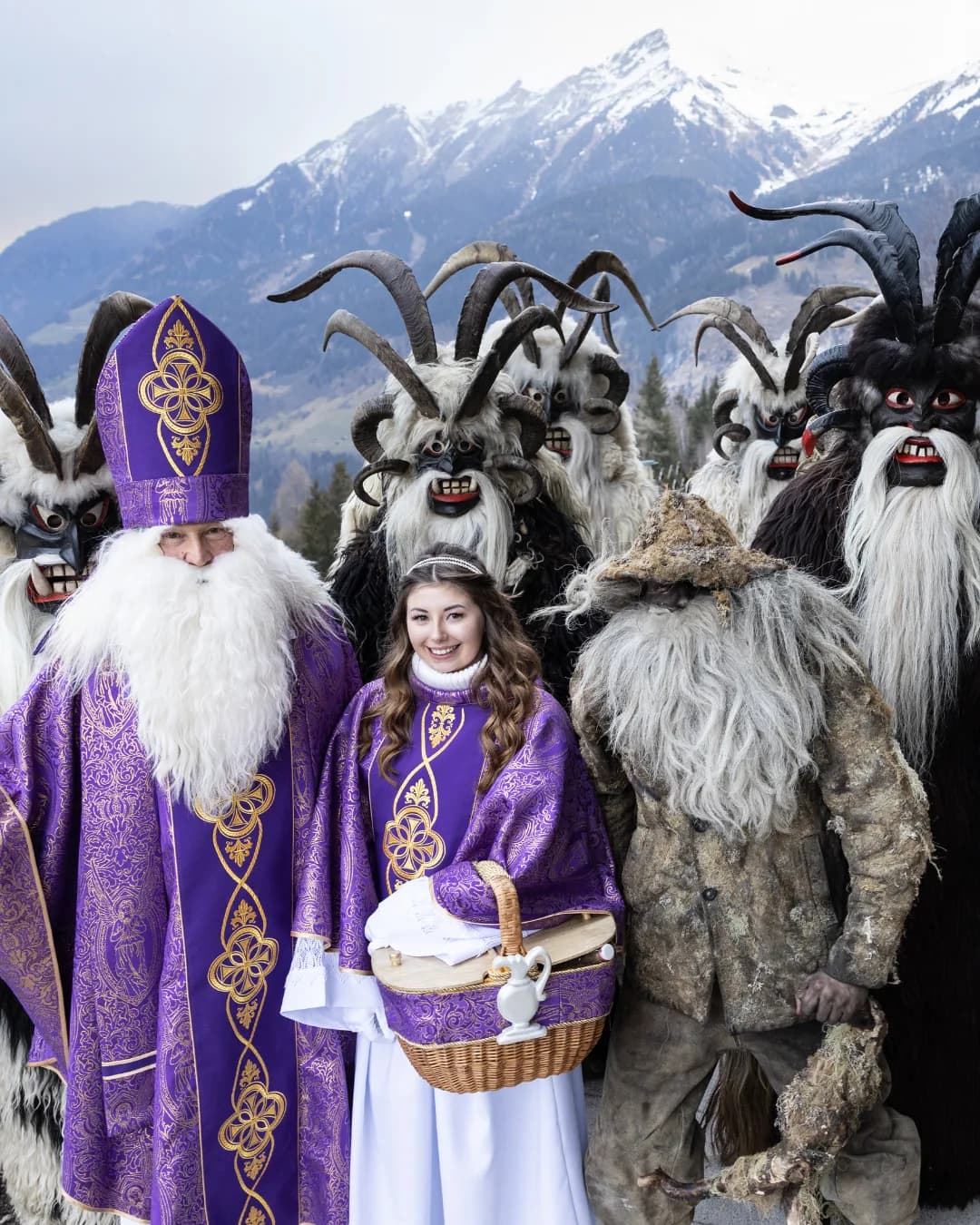
St Nicholas' Day on 6 December goes back to Nicholas of Myra — born around 270 in Patara, died in 343 in Myra, bishop in Lycia. Both places are in today's Turkey: Patara near Kaş, Myra at present-day Demre, both in Antalya province. From this figure the character of Father Christmas developed over the centuries.

Our two-day trip falls exactly on that day. In Alsace people eat Mannele on St Nicholas' Eve, the butter brioche in the shape of a little man, traditionally with hot chocolate. In the Netherlands 5 December is “pakjesavond”, the real gift-giving evening — more important than Christmas itself; surveys suggest nine in ten Dutch people exchange gifts at Sinterklaas but only seven in ten at Christmas. Only afterwards does the decoration change: chocolate letters disappear, Christmas trees go up.

Our Amsterdam departure on 6 December lands on exactly that transition day. Two countries, the same saint, two completely different customs — in a single weekend.

Historically the sources describe him as an Anatolian Greek; the places of his birth and his work lie within present-day Antalya.

Good to know

Small things that make the day easier.

Paying: four countries, four habits

In the Netherlands many stalls take cards only and no cash — some accept debit but not credit cards. In Belgium every trader must offer both cash and an electronic method. In Germany cash is still the rule at Christmas markets. In France cards are widespread but not guaranteed at small chalets.

Deposit on the cup

In Strasbourg officially €1 per cup, refundable at any drinks stand — or leave it in one of the donation boxes and the euro goes to a Strasbourg charity. The other cities publish no figure; a few euros is usual. Small change is worth having.

Warm, waterproof, in layers

You will be standing more than walking. Layers, waterproof shoes with a decent sole and gloves do more than the thickest coat. For Monschau that goes double: the coldest and wettest of the five.

The hour makes the market

At our destinations the sun sets between 16:30 and 16:41, and it is fully dark about 35 minutes later. Our schedules are built so that you are on site for that hour.

Bring your ID

All destinations are within the Schengen area, so there are no routine border checks. Even so, carry your identity card or passport — spot checks are always possible, and travel is not possible without a valid document.

Where the coach stops

Strasbourg: Parc de l'Étoile, about 15 minutes' walk into the old town. Colmar: drop-off at the Parking Lacarre; at weekends the coach then pays to park at the Parc des Expositions. Amsterdam: vehicles over 7.5 t may not enter the centre, so we use one of the designated points. Bruges: Bargeplein, about 20 minutes on foot.

Frequently asked questions

What people ask most before booking.

Where do the Christmas market coach tours depart from?
Every departure on this page starts from four fixed boarding points in North Rhine-Westphalia: Dortmund, Duisburg, Essen and Düsseldorf. You receive the exact boarding point and time with your booking confirmation.
How much does a Christmas market trip cost?
Day trips start at €49 per person (Amsterdam Light Festival, Bruges & Ghent), Monschau is €59 and Colmar & Riquewihr €99. The two-day trip to Strasbourg and Colmar with one hotel night is €169 per person.
Is entry to the Christmas market included?
The markets themselves are free to enter; there is no admission charge. The tour price covers return coach travel, the tour escort and compulsory travel insurance. Food, drink and optional extras such as the Amsterdam canal cruise are paid locally.
How long do we stay?
Day trips allow several hours on site, deliberately timed to include dusk: at our destinations the sun sets between 16:30 and 16:41, and it is fully dark about 35 minutes later. The exact duration is set out in each tour's programme.
How busy does it get?
Strasbourg itself names Wednesday afternoon, Friday evening and the entire weekend as the busiest times — our departures fall at the weekend. Plan the market early in the day and move later to quieter areas such as La Petite France or the Marché OFF.
Can I travel with children?
Yes. Colmar has a dedicated children's market in the Petite Venise with animals, a mechanical nativity, a carousel and hot apple juice; in Strasbourg the Village de l'Avent on Square Louise Weiss offers free storytelling and workshops daily. Please tell us the number and ages of children when you enquire.
Are there alcohol-free drinks?
Yes. Hot chocolate is available everywhere, Kinderpunsch at the German markets, and Colmar itself lists hot apple juice as part of the children's programme. Worth knowing: vin chaud and Glühwein contain alcohol, as does the Alsatian Berawecka fruit bread, which is steeped in kirsch. The Mannele is alcohol-free.
What documents do I need?
A valid identity card or passport. All destinations are within the Schengen area; travellers who are not EU nationals travel under the terms of their residence permit. Please check in good time that your documents remain valid beyond the travel date.
How do I book and pay?
Book through the form on the relevant tour page or directly via WhatsApp. We check availability and confirm your booking; payment is by bank transfer and the reservation becomes binding once the deposit is received.
What happens in bad weather?
Departures run in any weather – Christmas markets are open-air events and stay open in rain or snow. Only if the safety of the journey cannot be assured, for instance during an official severe weather warning, will we contact you in good time about alternatives.

Still deciding?

Tell us how many of you are travelling and we will suggest the right date and keep your seats together. For groups of 20 or more we also travel on the date of your choice.